Reverse osmosis is now a standard component of industrial water treatment and ZLD systems across India. RO systems efficiently produce high-purity permeate water for process reuse — but they concentrate everything they reject into a stream that is typically 20–30% of the original feed volume and 3–4 times as concentrated in dissolved solids.
For most industries, this RO reject has historically gone to a Multi-Effect Evaporator (MEE) for terminal evaporation under ZLD compliance — generating large volumes of mixed salt cake for hazardous waste disposal. But this is the least profitable way to handle a stream that can contain commercially valuable salts, recoverable chemicals, and reusable water.
Geist Research's approach to RO reject turns this problem into a resource recovery opportunity — extracting specific salts and chemicals before terminal evaporation, reducing MEE operating costs, and generating saleable products from what would otherwise be a disposal cost.
What Is Actually in Your RO Reject?
The composition of RO reject varies significantly by industry and feed water source. Understanding what is in your specific reject stream is the starting point for any resource recovery strategy.
| Industry | Typical RO Reject Composition | Key Recoverable Value | Recovery Route |
|---|---|---|---|
| Chemical / Pharmaceutical | High TDS, sulphates, chlorides, trace organics | Sodium sulphate, Epsom salt | Selective crystallisation |
| Textile / Dye | Na₂SO₄, NaCl, colour bodies, COD | Sodium sulphate (post decolourisation) | MEE + crystallisation |
| Agrochemical / Specialty | Bromides, sulphates, organics | Bromine, sodium sulphate | Chlorine stripping + crystallisation |
| Paper / Pulp | Calcium, sodium, sulphate, COD | Calcium sulphate, sodium sulphate | Precipitation + crystallisation |
| Pharmaceutical (MgSO₄ processes) | Magnesium sulphate, sulphates | Epsom salt (MgSO₄·7H₂O) | Cooling crystallisation |
Geist Research's Approach to RO Reject Treatment
Rather than feeding RO reject directly to a terminal MEE — which produces mixed, low-value salt cake — Geist designs a selective recovery sequence upstream of the MEE. This extracts specific high-value chemicals first, leaving a smaller, less complex stream for terminal evaporation.
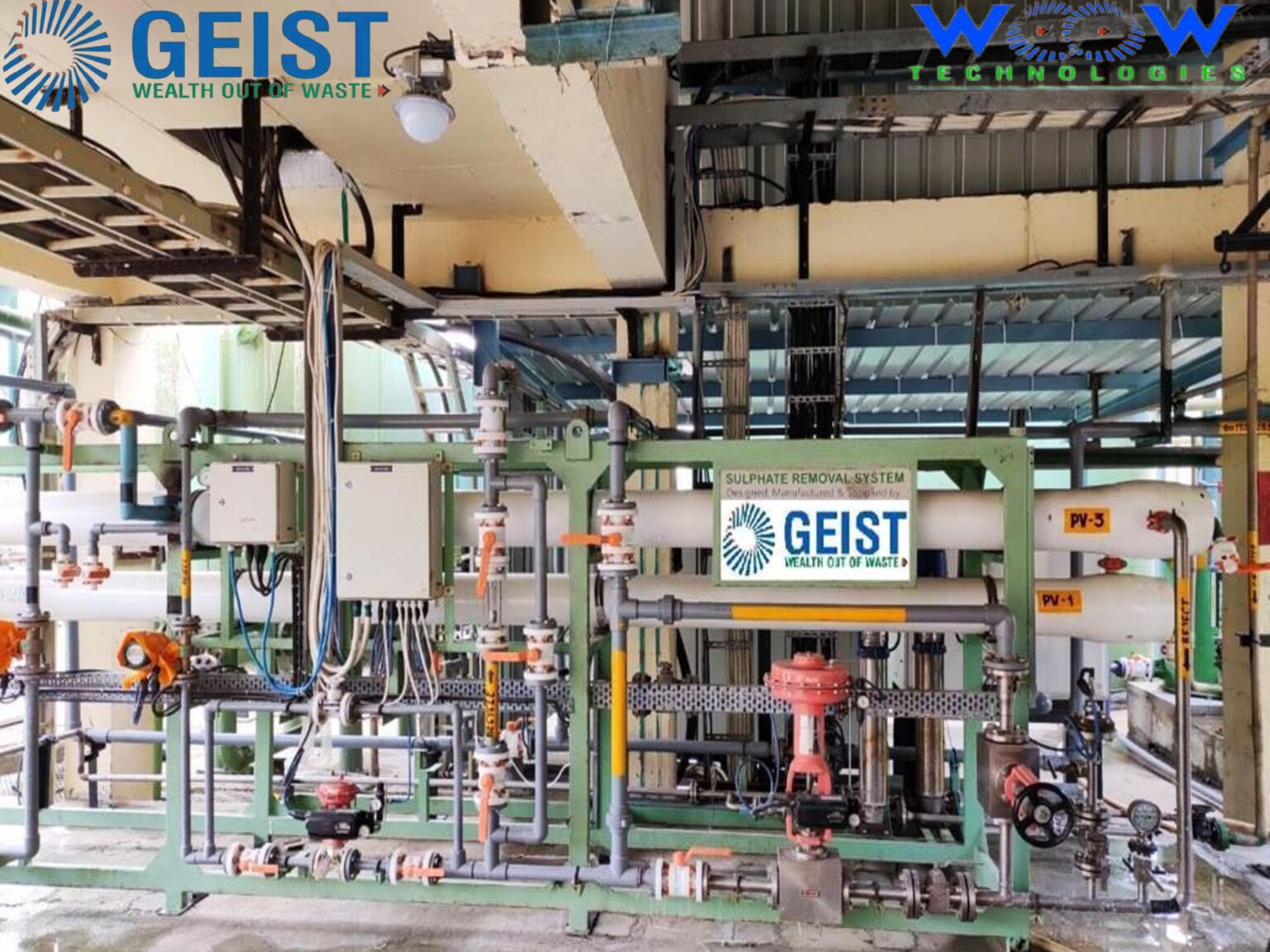
Reject Stream Characterisation & Mass Balance
Before designing any treatment sequence, a thorough characterisation of the RO reject is conducted — 24-hour composite sampling, full ionic analysis (sulphate, chloride, sodium, potassium, magnesium, calcium, bromide), organic loading (COD, TOC), and TDS. This determines which salts are present in recoverable concentrations and in what sequence they should be extracted.
Organic Removal & Pre-Treatment
RO reject from pharmaceutical or chemical plants often contains residual organics (COD) that would contaminate recovered salts. Pre-treatment removes these via activated carbon adsorption, advanced oxidation (ozone/Fenton), or biological polishing — before the reject enters the concentration and crystallisation sequence. Clean reject produces clean, marketable salt products.
Further Concentration via Second-Stage RO or MEE
The pre-treated RO reject is further concentrated — either via a second-stage high-pressure RO (for streams with lower TDS) or directly via MEE (for streams already at high TDS). Concentration increases the driving force for selective crystallisation and reduces the volume of liquid requiring further processing.
Selective Salt Crystallisation
Using controlled temperature and concentration profiles, specific salts are selectively crystallised from the concentrated reject in a defined sequence. Epsom salt (MgSO₄·7H₂O) crystallises preferentially during controlled cooling of magnesium-rich streams. Sodium sulphate crystallises during evaporative concentration. Each salt is harvested separately, centrifuged, dried, and quality-certified before sale.
Terminal Evaporation of Residual Stream
After selective recovery of high-value components, the remaining residual stream — now much smaller in volume and lower in recoverable value — goes to terminal MEE and crystalliser for full ZLD. Because the bulk of the valuable salts have already been extracted, the terminal solid is a smaller quantity of lower-value mixed salt — reducing hazardous waste disposal costs significantly.
What Can Be Recovered from RO Reject?
🧂 Sodium Sulphate (Na₂SO₄)
The most commonly recovered salt from industrial RO reject in India. Crystallises from sulphate-rich concentrate via MEE + crystallisation. Market price ₹3,500–7,000/MT. Sold to detergent manufacturers and glass producers.
💊 Epsom Salt (MgSO₄·7H₂O)
Magnesium sulphate heptahydrate — recoverable from RO reject streams rich in magnesium and sulphate. Sells at ₹8,000–15,000/MT. Buyers include pharmaceutical, agricultural (fertiliser), and food-grade magnesium supplement producers.
🔴 Bromine (Br₂)
Recoverable from RO reject of agrochemical and specialty chemical plants using bromide-containing raw materials. Bromine is extracted via chlorine oxidation and steam stripping. Market price ₹80,000–1,50,000/MT. Used in flame retardants, pharmaceuticals, and fine chemicals.
🧊 Sodium Chloride (NaCl)
Industrial-grade salt recovered from high-chloride reject streams. Lower unit value than sulphate salts but large volume makes it commercially worthwhile. Used in water softening regeneration, chemical manufacturing, and road de-icing.
ZLD Compliance & Regulatory Benefits
RO reject treatment with integrated resource recovery delivers compliance benefits beyond simple ZLD achievement:
- Eliminates liquid discharge to water bodies or land — full ZLD compliance under environmental regulations
- Reduces mixed salt cake volume by 40–70% vs. direct MEE treatment — lowering hazardous waste disposal costs
- Converts salt cake from a classified hazardous waste (disposal cost) into a classified commercial product (revenue)
- Reduces MEE operating costs by lowering the feed volume and organic loading to terminal evaporation
- Improves environmental performance score for export compliance and ESG reporting
What Is in Your RO Reject?
Geist Research provides RO reject characterisation and resource recovery feasibility studies — identifying which salts are recoverable at your plant and what the ROI looks like.
Request RO Reject Assessment Contact Our EngineersGeist Case Studies
RO Reject Resource Recovery — Live Projects
Geist has extracted commercially valuable salts from concentrated RO reject across chemical, specialty chemical, and dye industries.

High-TDS dye effluent concentrate → industrial-grade sodium sulphate. Salt recovery upstream of terminal MEE, reducing evaporation load by 60–80%.

Sodium sulphate and sodium carbonate both extracted selectively from one concentrated reject stream — demonstrating Geist's selective crystallisation in action.

Magnesium-rich agrochemical RO reject → purified Epsom salt (MgSO₄·7H₂O). Eliminates terminal evaporation volume and generates agricultural-grade product revenue.